

The Challenge of GBM
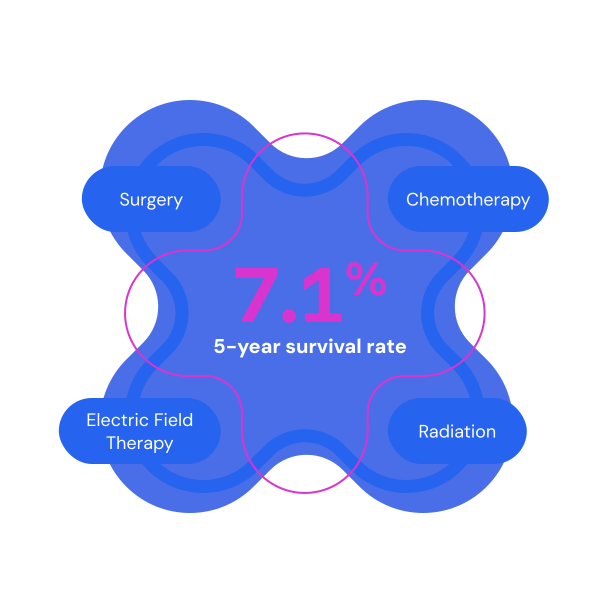
Glioblastoma (GBM) is among the most lethal and treatment-resistant cancers. Despite more than a century of research and multiple FDA-approved therapies, median overall survival has changed little. Molecularly targeted drugs and immune checkpoint inhibitors that transformed outcomes in other cancers have shown limited benefit in GBM, underscoring the need for new pharmacologic modalities that can act locally within the brain’s unique microenvironment.
Existing standard therapies are associated with significant side effects and treatment burden, and overall outcomes remain poor. There remains a critical unmet medical need for therapies that achieve potent, localized activity without increasing systemic burden.
How Our Therapy Works
Alpheus is developing an investigational therapy that pairs a tumor-accumulating drug with low-intensity ultrasound to achieve localized activation inside the brain — an approach sometimes referred to as sonodynamic therapy (SDT).
Patients receive 5-aminolevulinic acid (5-ALA), a well-characterized molecule already approved by the FDA for visualizing brain tumors during surgery. In glioblastoma, 5-ALA is converted into protoporphyrin IX (PpIX), which preferentially accumulates in tumor cells because of their altered metabolism. Healthy brain tissue shows minimal uptake under normal physiologic conditions.
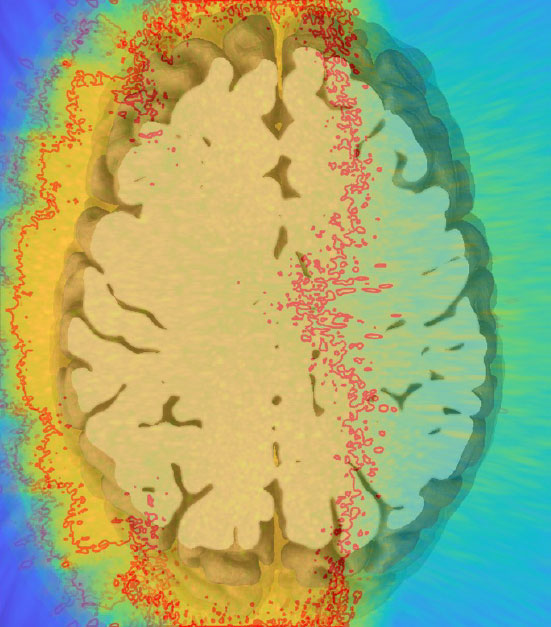
After the drug has accumulated, the Alpheus LIDU® system delivers low-intensity, diffuse ultrasound across the affected brain hemisphere. Research suggests that ultrasound exposure can interact with intracellular PpIX to generate reactive oxygen species (ROS), which may contribute to tumor-cell injury and support immune-mediated clearance of dying cells.
The aim of this approach is to create localized, drug-mediated tumor cell killing while minimizing systemic exposure. Safety and effectiveness are currently being evaluated in clinical trials.
Evidence From our Studies
The Alpheus program is built on a stepwise translation from preclinical models to ongoing randomized evaluation in patients. Each study was designed to establish feasibility, characterize safety, and explore biological and clinical signals consistent with localized drug activation. Findings remain preliminary and investigational, and cross-study comparisons should be avoided.
Preclinical
Phase 1
Phase 1b
Phase 2
Phase 2b
Status
Companion Canine GBM
Preclinical
Phase 1
Phase 1b
Phase 2
Phase 2b
Status: Completed
Studies in pet dogs, the only other species that spontaneously develops glioblastoma, demonstrated localized tumor necrosis and improved median survival compared with center-matched historical controls. These results are from an animal study and may not predict human outcomes1.
Recurrent GBM
Preclinical
Phase 1
Phase 1b
Phase 2
Phase 2b
Status: Completed
A first-in-human feasibility study in recurrent glioblastoma evaluated localized, ultrasound-mediated drug activation. The therapy was well tolerated in a small cohort, with preliminary imaging and survival trends consistent with localized drug activation2. These early findings require confirmation in larger, controlled studies.
Newly Diagnosed GBM
Single Treatment
Preclinical
Phase 1
Phase 1b
Phase 2
Phase 2b
Status: Completed
A pilot study combining a single treatment with standard of care demonstrated procedural feasibility and acceptable tolerability. Exploratory signals of biological activity were observed; efficacy has not been established3.
Newly Diagnosed GBM
Safety Lead-In
Preclinical
Phase 1
Phase 1b
Phase 2
Phase 2b
Status: Enrollment Complete (Follow-up Ongoing)
The Phase 1b safety program evaluated both first-generation and next-generation treatment systems in newly diagnosed glioblastoma. Across these cohorts, therapy was feasible and generally well tolerated, with no dose-limiting toxicities observed. Procedural reliability and device performance were confirmed with the next-generation platform, which is the configuration used in the pivotal Phase 2b trial. Exploratory signals of biological activity were observed but are preliminary and derived from small sample sizes; efficacy conclusions cannot be drawn.
Newly Diagnosed GBM
RCT
Preclinical
Phase 1
Phase 1b
Phase 2
Phase 2b
Status: Active / Enrolling
A randomized, controlled Phase 2b trial in newly diagnosed glioblastoma is underway. The study is designed to evaluate safety and efficacy under an IRB-approved protocol and is being conducted in accordance with applicable regulatory standards. Enrollment is ongoing.
Therapeutic Differentiation
Alpheus’ investigational therapy is distinguished by its drug-centered approach and by the design of its ultrasound delivery system (LIDU®), which is intended to provide diffuse, hemispheric coverage consistent with the infiltrative nature of glioblastoma. This design aims to support broad, localized drug activation across the tumor region—a different approach from focused ultrasound technologies developed for discrete, focal targets.
Together, the selective accumulation of the drug and the system’s coverage geometry represent a therapeutic concept designed to be both localized and repeatable. The potential clinical benefit of this approach is currently being evaluated in ongoing studies.
A Platform
Beyond GBM
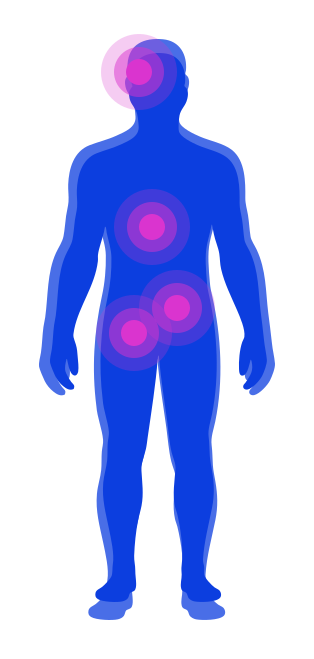
While Alpheus’ lead program focuses on glioblastoma, the underlying drug-and-ultrasound approach is being explored for potential application in other solid tumors where selective drug accumulation and localized activation may be relevant.
This strategy combines a pharmacologic substrate with a well-characterized safety profile and an adaptable, low-intensity ultrasound field. Together, these elements may allow tumor-selective pharmacologic activation in anatomic sites beyond the central nervous system, including early preclinical investigations in non-CNS solid tumors.
These programs remain early-stage and investigational, and their clinical feasibility has not been established. Any future indications would require full clinical development and regulatory approval.
References: 1. Arnold SA, Taylor AR, Hansen K, Agarwal V, Low WC, Pluhar GE. Immunotherapy yields breed-specific worst survival outcomes among three investigated therapies in French bulldogs with high-grade glioma. Front Vet Sci. 2025 Mar 19;12 2. Alpheus Medical press release: Positive Phase 1/2 results of sonodynamic therapy in recurrent GBM (2023), https://www.alpheusmedical.com/alpheus-medical-announces-positive-phase-1-2-trial-results 3. Early clinical results of sonodynamic therapy in newly diagnosed GBM (2024), https://www.alpheusmedical.com/early-clinical-results-of-sonodynamic-therapy/